

- Methods:
- increasing pin diameter:
- most important factor in fixator stability;
- adult tibia: usually requires fixation w/ 4.5 to 6.0 mm pins;
- pins must be < 1/3 bone diameter to prevent pin hole fractures;
- reference:
- Biomechanical analysis of pin placement and pin size for external fixation of distal radius fractures.
- widely separated pins within single fragment;
- placement of pins near the fracture site;
- number of pins:
- three pins usually provide axial stability even w/ segmental comminution;
- little is gained w/ a 4th pin in single segment;
- short fragments fixed w/ 2 pins in same plane will provide stability in plane of pins but will be relatively unstable in plane at a right angle to the pins;
- number of support bars:
- additional planes of fixation:
- a short fragment may not allow 3 pins in single plane but may allow additional pins in a different plane;
- unilateral external fixators must stabilize the frx from an eccentric off axis position, and are most able to control frx site bending and shear when there is frx site opposition;
- multiplane fixation or circular wire fixators help limit frx site bending and shear and allow load sharing at the frx site;
- proximity to the extremity: (decreasing bone to support bar distance)
- fibular fixation:
- see frx of the tibia w/ intact fibula;
- reference: Plating of the fibula. Its potential value as an adjunct to external fixation of the tibia.
Fracture Site Motion with Ilizarov and "Hybrid" External Fixation.
- biomechanical study which compared stability of Ilizarov fixator to a Hybrid fixator in a frx model;
- findings:
- in a completely unstable frx model, a four ring Ilizarov fixator has substantially more stability than a unilateral Hybrid fixator;
- weakness of study:
- most fractures have at least some bone apposition which confers load sharing;
- the frx model used in their study used longer half pins than would be used for most tibial frx;
- as would be expected, increasing the distance between the half pins and bone will decreased frx stability;
- in most cases, Ilizarov transfixation wires cannot be placed at right angles to each other, and therefore, the construct will not be as stable as the one in the biomechanical study;
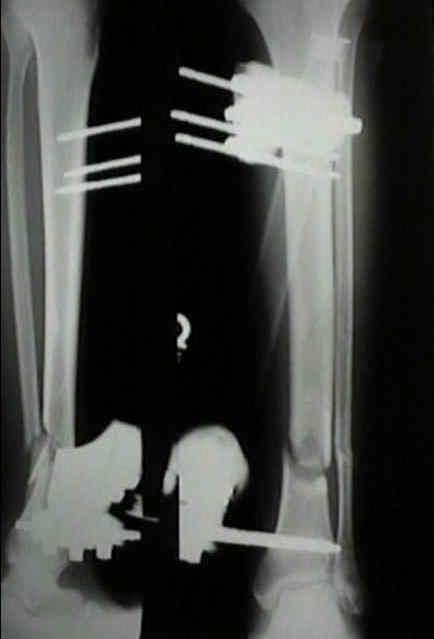
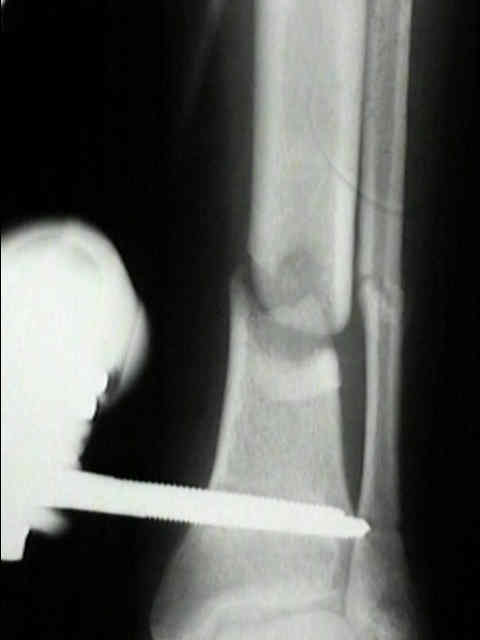
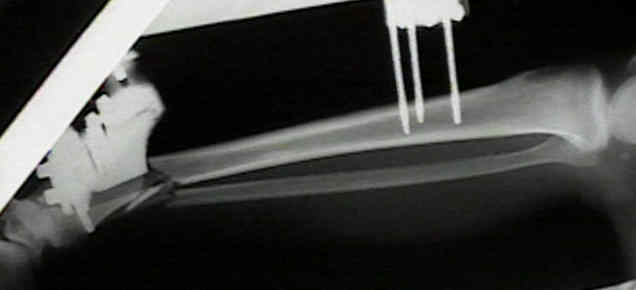
- Case Example:
- 30-year-old prisoner who sustained a patellar fracture and a distal tibia fracture;
- he was treated w/ an external fixator but several treatment principles were ignored;
- the fracture was left distracted, the pins were not spread out and were placed well away from the fracture site, and the fixator bar was not near the skin;
- as might be expected, this went on to a non union
Plating of the fibula. Its potential value as an adjunct to external fixation of the tibia.
Fracture Site Motion with Ilizarov and "Hybrid" External Fixation
Mechanical considerations in using tensioned wires in a transosseous external fixation system.
The effect of rigidity on fracture healing in external fixation.