- Discussion:
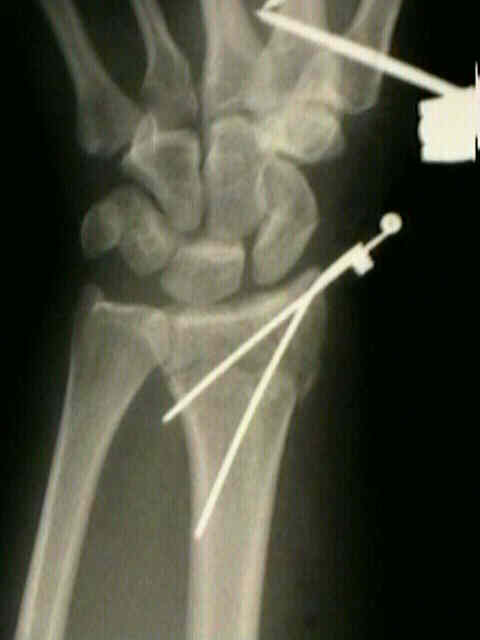
- Kapandji's Technique / Intra Focal Pin Fixation:
- a technique in which pins are inserted into the fracture site which are then used to pry the distal fragment into optimal position;
- indicated for extra-articular distal radial fractures w/ good bone stock;
- using flourscopy, pins are driven into the frx site in a proximal to distal direction;
- correction of dorsal angulation:
- intrafocal pin is inserted from the dorsal-ulnar side to reestablish the volar tilt
- drive pins into the dorsal cortex, apply a levering action in a volar direction, and drive into the volar cortex;
- correction of radial inclination:
- to correct loss of radial inclination, drive pins along the radial cortex;
- inserted from the volar radial side to reestablish the radial inclination and the radial length
 - the pins are then levered until the proper anatomy is restored, and subsequently the pins are then driven proximally and oblique into the cortex of the proximal fragment;
- disadvantages:
- intra-focal pinning by itself does not provide rigid fixation and often requires concomitant external fixation;
- propensity for collapse in older patients, especially when comminution is present (since frx fragments can slide along the pin
[Internal fixation by double intrafocal plate. Functional treatment of non articular fractures of the lower end of the radius (author's transl)].
Intrafocal (Kapandji) pinning of distal radius fractures with and without external fixation.
Intrafocal (Kapandji) pinning of unstable distal radius fractures: a preliminary report. The unstable distal radial fracture one year post
Two procedures for Kirschner wire osteosynthesis of distal radial fractures. A randomized trial.
Results of distal radial fractures treated by intra-focal pin fixation.