

- Discussion:
- capitellum is hypoplastic and the radial head is ovoid or dome-shaped;
- ulna may be short in relation to the radius;
- in about 1/3 of patients there will be an additional anomaly of the upper extremity, and in about 1/3, there will be an anomaly in other
parts of the body;
- an isolated congenital dislocation of the radial head is uncommon;
- pts are often asymptomatic despite sl loss of extension and supination;
- Exam:
- pts are often asymptomatic (as in this case) despite the slight loss of extension and supination;
- activities requiring full supination may be difficult;
- radial head prominence will be noted in many patients;
- Radiographs: 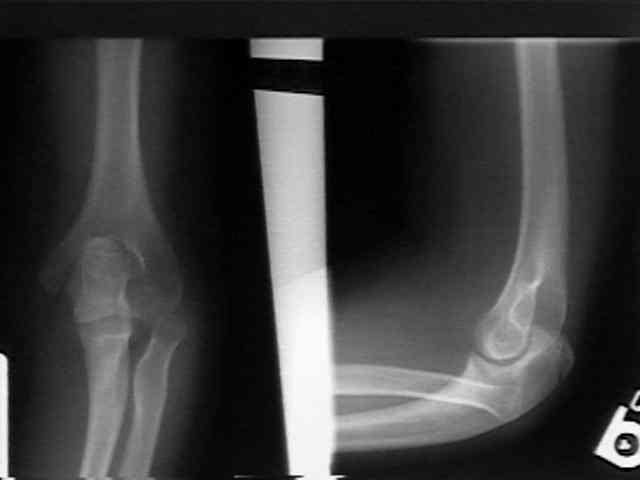
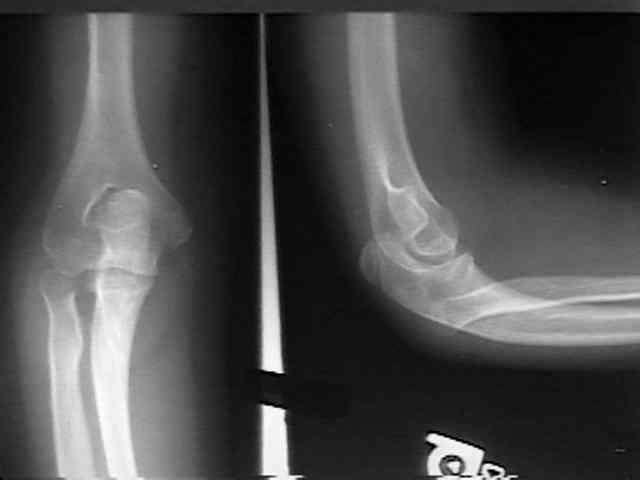
- Non Operative Treatment:
- treatment is directed to alleviating pain, increasing motion, and improving appearance;
- if pt is doing well, recommended treatment is observation;
- Operative Treatment:
- excision of radial head is contraindicated in a skeletally immature pt, but this may be option if the patient develops pain as adult;
- less than 5-10 % of patients will have pain severe enough to warrent surgery, but in this group, excision of the radial head will
afford significant pain relief;
- excision of the radial head is not expect to improve range of motion
Anterior dislocation of the head of the radius. McFarland B. Br J Surg. 1936;24:41-49.
Excision of the radial head for congenital dislocation.
Anterior dislocation of the radial head in children.
Congenital radial head dislocation.
Congenital dislocation of the radial head: Spectrum and natural history.