

- Discussion:
- injury may develop over weeks so patient needs to be followed closely;
- need to determine if triangular ligament is intact;
- see if pt can maintain active PIP Joint extension;
- if triangular ligament is intact, then non operative treatment is more likely to succeed;
- Splinting:
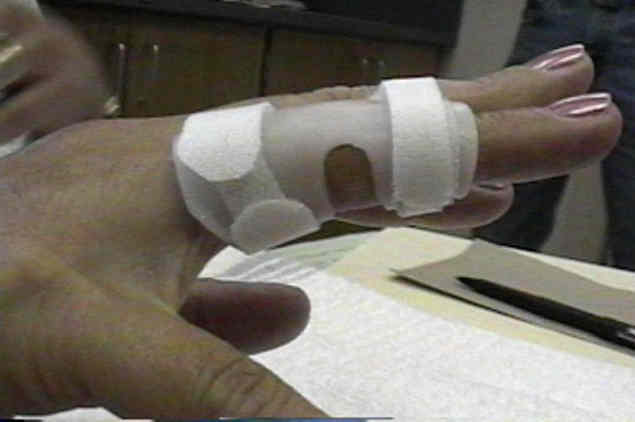
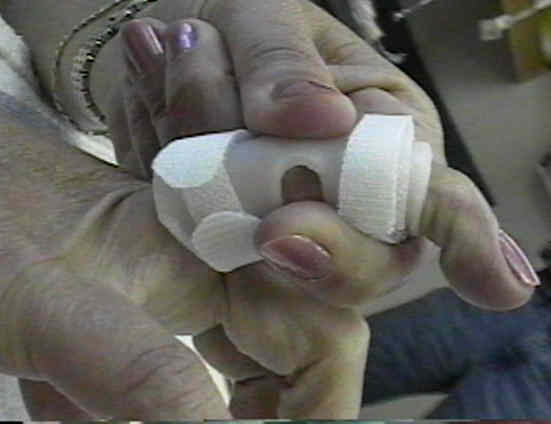
- lesion w/o frx may be treated closed, by splinting PIP joint in full extension for 6 to 8 wks, then at nite for 4 wks;
- during the first 6 weeks, the splint must be worn at all times w/ no exceptions;
- DIP joint should not be immobilized - it must be actively & passively flexed during treatment;
- ability to actively flex the DIP joint (w/ PIP in extension) indicates progress in healing;
- chronic deformity:
- some believe that the presence or absence of a fixed joint contracture is most important for successful splintting;
- splinting may be effective as late as 1-3 month post injury (esp w/ loose joints);
- chronic boutonniere deformity with loss of passive PIP motion may be treated w/ saftey pin splint with gradual daily tightening of splint over several weeks until PIP joint obtains full passive motion;
- this may be successful even upto 6 months following injury;
- Inclusion of MP Joint:
- in some cases, it will be necessary to include MP and wrist joints in the splint;
- the MP joints are held in extension for 3-4 weeks (which has the effect of relaxing the central slip and the lateral bands);
- obviously, it is important to avoid MP joint extension contracture, and this method should not be used if MPJ flexion is limited;
- after 3-4 weeks the splint is exchanged for a finger splint