

- Discussion:
- anatomy of ACL;
- ACL biomechanics;
- graft tunnel sites / isometry:
- hamstring ACL reconstruction is an alternative to bone patellar bone graft fixation;
- size and strength of graft:
- double looped hamstring graft is more than twice as strong as normal ACL, as compared to bone patella bone (which is 1.3
times as strong);
- this is true because more cicular shaped hamstring tendons have larger cross sectional area than a similarly sized BPB graft;
- 8 mm double graft has a cross sectional of 50 sq mm vs a 10 mm BPB graft which has a cross sectional area of 35-40 sp mm;
- minimum acceptable graft size is about 7 mm (small grafts are associated with a higher failure rate);
- references:
- Hamstring autograft size can be predicted and is a potential risk factor for anterior cruciate ligament reconstruction failure.
- Graft size not the only factor in determining better ACL reconstruction outcomes
- Impact of Hamstring Graft Diameter on Tendon Strength: A Biomechanical Study
- preoperative considerations.
- some surgeons elect to use hamstrings in patients who have had previous patellar tendon harvest or who have pre-existing
patellofemoral arthrosis;
- in the uncommon case of concomitant ACL-PCL ruptures, often the bone patella bone graft is used for the PCL reconstruction,
and hamstrings are used for ACL reconstruction;
- main disadvantage of hamstrings is that the reconstruction is less stiff than BPB grafts, since a longer graft length (with
fixation outside of femoral and tibial tunnels) will undergo more strain;
- advantages:
- hamstring grafts allow more anatomic placement into the femoral foot print (as with the AM technique)
- there is the allowance for differential tensioning (posterior 2 halves can be fixed with a staple in 10 deg of flexion, and
the anterior two haves can be fixed with an interference screw in 40 deg flexion;
- PreOp Evaluation:
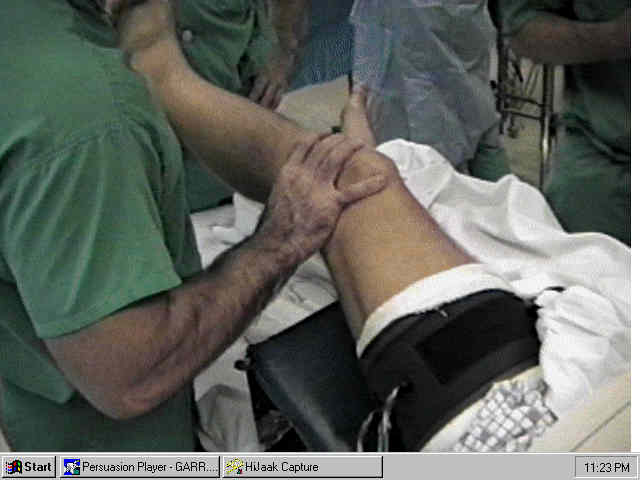
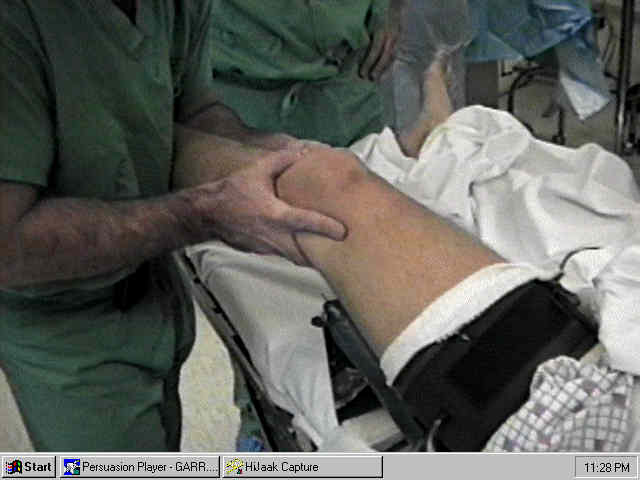
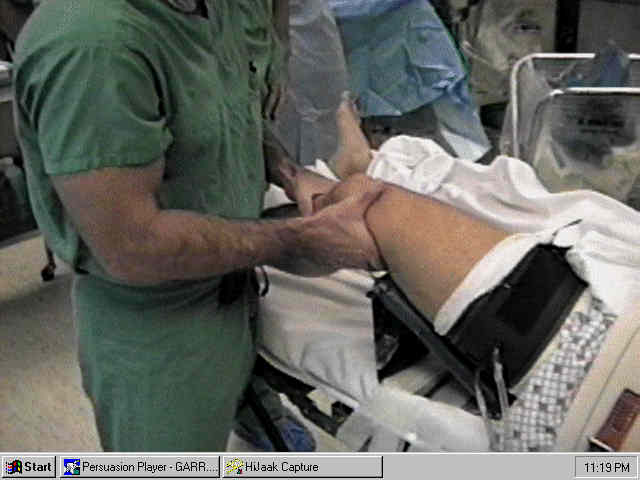
- Surgical Technique:
- positioning and setup:
- hamstring harvest:
- references:
- A surgical technique using presoaked vancomycin hamstring grafts to decrease the risk of infection after anterior cruciate ligament reconstruction.
- The In Vitro Elution Characteristics of Vancomycin from Tendons
- knee arthroscopy
- notchplasty:
- tibial tunnel:
- consider undersizing reaming diameter and then using dilators at the distal aspect of the tunnel;
- this will better accomodate the distal end of the graft which often is of larger diameter than the rest of the graft;
- using this technique, allows the distal (wider diameter) end of the graft to act as a "stop" to proximal migration (in addition to
interference screw);
- femoral tunnel:
- consider more posterior femoral tunnel with hamstring grafts noting their increased flexibility compared to BPB grafts;
- by placing the knee in a partial figure 4 position, a transtibial technique can be performed which is essentially the equivalent of
the anteromedical technique;
- graft fixation:
- goal is to have 2 grafts tight in extension and two grafts tight in flexion;
- identify the 2 posterior halves of the graft, and place them under maximum tension with the knee in 10 deg flexion.
- an 8 mm staple is straddled across these grafts about 1 cm distal to the tunnel, and impacted into place;
- then the two anterior halves are placed under maximal tension, and the knee is placed in 45 deg flexion;
- the interferences screw system is then applied;
- after interference screw fixation of the tibial graft, there will often be a large residual portion of tendon graft which overhangs
from the tibial tunnel;
- these overhanging graft ends may be sutured to the proximal tibial periosteum for additional fixation
- Post Op Care of ACL Reconstructions
- References:
The use of hamstring tendons for anterior cruciate ligament reconstruction. Technique and results.
Arthroscopically Assisted Reconstruction of the Anterior Cruciate Ligament. A prospective randomized analysis of three techniques.
Clinical Outcome of Anterior Cruciate Ligament Reconstruction with Quadrupled Hamstring Tendon Graft and Bioabsorbable Interference Screw Fixation.
A Randomized Comparison of Patellar Tendon and Hamstring Tendon Anterior Cruciate Ligament Reconstruction.
Anterior Cruciate Ligament Reconstruction with a Four-Strand Hamstring Tendon Autograft.
Muscle and Tendon Morphology After Reconstruction of the Anterior Cruciate Ligament with Autologous Semitendinosus-Gracilis Graft.
Anterior Cruciate Ligament Reconstruction: Bone-Patellar Tendon-Bone Compared with Double Semitendinosus and Gracilis Tendon Grafts. A Prospective, Randomized Clinical Trial
Hamstring Tendon Versus Patellar Tendon Anterior Cruciate Ligament Reconstruction Using Biodegradable Interference Fit Fixation: a Prospective Matched-Group Analysis.